
If you are planning a new driveway, patio, or sidewalk, one of the smartest questions you can ask before hiring anyone is simple: when should this actually get poured? In Central Iowa, timing is not a small detail. It shapes how strong the finished surface will be, how likely it is to crack or scale, and how long it will last. The best time to pour concrete in Central Iowa is late spring, roughly late April through early June, and early fall, from September through October. Those windows give concrete the steady, moderate conditions it needs to cure properly.
That does not mean the other months are off limits. Concrete gets poured here year round, and a skilled crew can produce excellent results in July heat or a cold November with the right precautions. But every season carries tradeoffs, and understanding them helps you plan your project, set a realistic budget, and know what to expect. Below, we break down why timing matters so much in our climate, what happens in each season, and how to make the right call for your property.
How Temperature and Iowa Weather Affect Your Concrete Pour
Concrete does not simply dry. It cures, which is a chemical reaction called hydration that binds the mix into a hard, durable surface. That reaction is sensitive to temperature and moisture. If it happens too fast, the surface can weaken. If it happens too slow, or if the mix freezes before it sets, the slab can fail entirely.
Central Iowa puts real pressure on that process. We sit in a climate with hot, humid summers and genuinely cold winters, and we cycle through both every year. Des Moines and the surrounding communities land in USDA hardiness zone 5, with an average last spring frost in early to mid April and a first fall frost around the first three weeks of October. That leaves a frost-free window of roughly six and a half months, and the shoulders of that window are exactly where the best pouring conditions live.
On top of the seasonal swing, Iowa concrete has to survive the freeze-thaw cycle for decades after it is poured. Water seeps into tiny pores in the surface, freezes, expands, and pushes the concrete apart, then thaws and does it again through every winter. Concrete that was poured and cured properly, with the right air-entrained mix, handles this cycle well. Concrete that was rushed or poured in poor conditions starts to scale, pit, and crack much sooner. This is why we use high-PSI concrete, fiber additives, and integrated sealants on every project, and it is why the season you pour in genuinely affects how long your investment lasts.
The Best Months to Pour Concrete in Central Iowa
Late spring and early fall are the sweet spots for a reason. In late April through early June, the ground has thawed and warmed, daytime highs are comfortable, and overnight lows have climbed above freezing. Concrete cures at a steady pace without the crew fighting the weather. Early fall, September through October, offers a similar balance on the other side of summer, with cooler air and lower humidity that support even, controlled curing before the first hard frost arrives.
These windows also tend to be kinder to your schedule and your finish quality. Crews are not racing evaporation the way they do in July, and they are not managing freeze protection the way they do in December. That translates into a smoother pour, better surface finishing, and a lower chance of the problems that show up months later. If you have flexibility in your timeline, aiming for one of these two windows is the single easiest way to protect the quality of your project. It is also a great time to consider add-on work like stamped and colored concrete, since decorative finishes benefit from the same controlled curing conditions.
One practical note: these are the busiest booking periods for concrete contractors across Central Iowa. If you want a spring or fall pour, reach out well ahead of time so your project fits the schedule.
Pouring Concrete in an Iowa Summer
July is the peak of construction season in Central Iowa, and plenty of excellent concrete gets poured in the summer. But summer is also where the biggest hidden risk lives, and it is worth understanding before you assume warmer is always better.
The problem is flash-drying. Under a blistering Iowa summer sun, combined with high humidity and warm ground, the surface water in fresh concrete evaporates too quickly. When the top layer dries faster than the concrete below it, you get surface scaling, plastic shrinkage cracks, and a weaker outer layer that wears down sooner. The concrete can look fine on day one and start showing trouble within a year or two.
A capable crew manages this rather than ignoring it. That means scheduling pours for early morning before the heat peaks, using evaporation retarders or a mix adjusted for hot weather, keeping the subgrade damp, and staying on top of curing with water or curing compounds in the critical first hours. The American Concrete Institute publishes hot weather guidance, ACI 305, precisely because summer pours demand this level of care. The takeaway for a homeowner is not to avoid summer entirely, but to make sure whoever you hire has a real plan for the heat rather than pouring on the hottest afternoon and hoping for the best.
Pouring Concrete in an Iowa Winter
Cold weather is the mirror image of the summer problem. Instead of curing too fast, concrete in the cold cures too slowly, and if the water in the mix freezes before the concrete gains strength, the slab is permanently compromised. As a general rule, fresh concrete needs to stay above 40 degrees Fahrenheit for the first several days while it sets.
That does not make winter pours impossible. When conditions call for it, contractors use heated mixing water, accelerating admixtures, insulating curing blankets, and sometimes ground heaters or enclosures to hold the concrete in a safe temperature range while it cures. The American Concrete Institute cold weather standard, ACI 306, exists for exactly this situation. Done correctly, a winter pour can turn out well. But it costs more because of the added materials and labor, it carries more risk if the weather turns, and it is more likely to face weather delays. For most homeowners, winter is a pour of necessity rather than choice, best reserved for projects that genuinely cannot wait until spring.
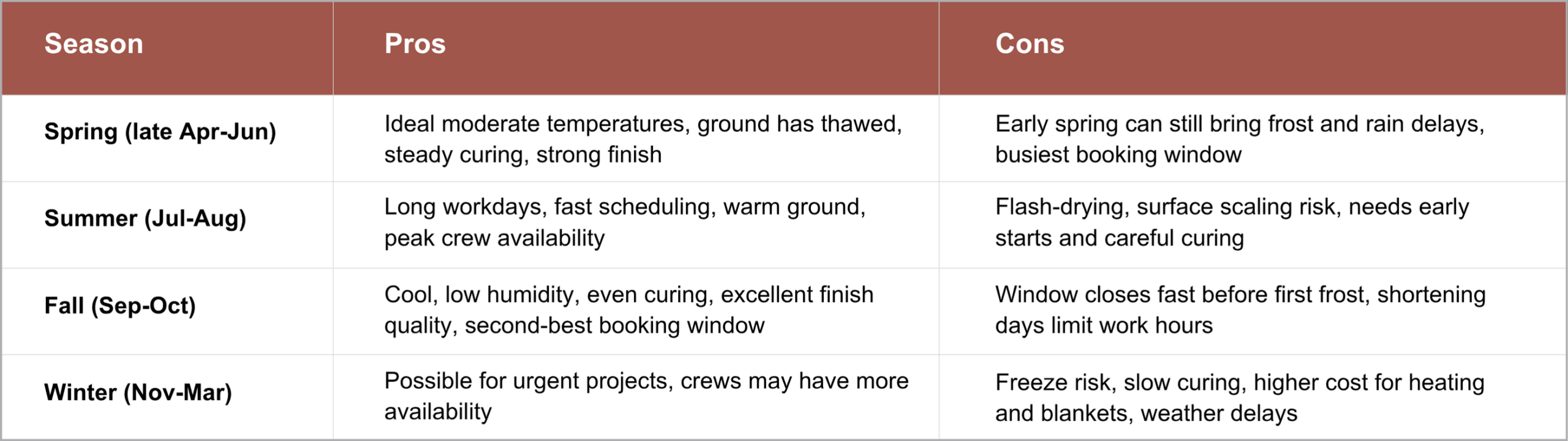
Season by Season: Pros and Cons
Every season has a case for and against it. Here is how they compare for a typical residential project in Central Iowa.
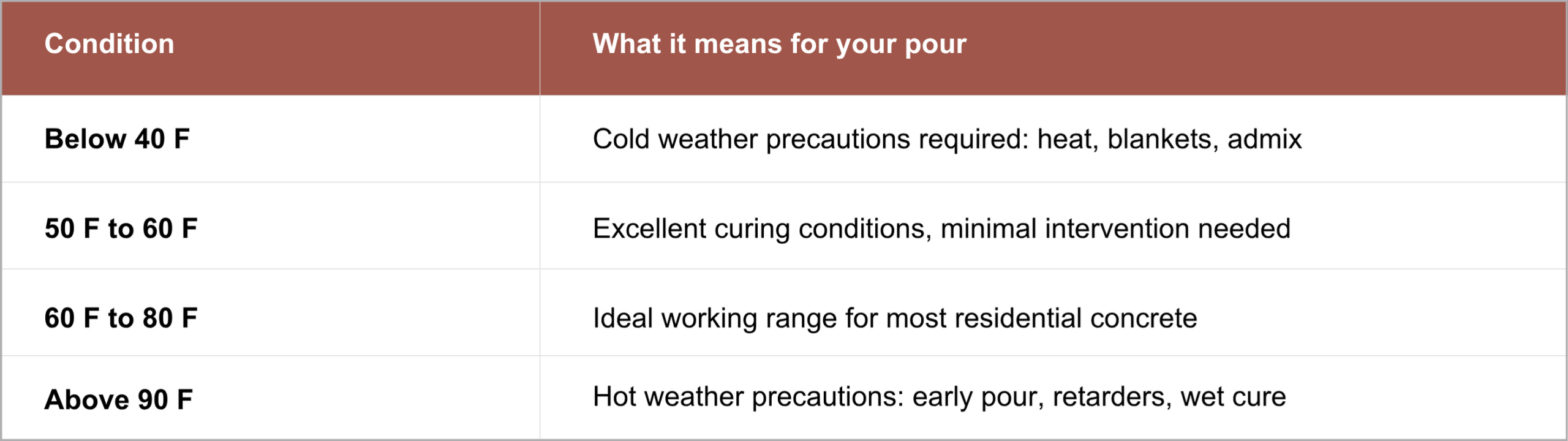
Temperature Guidelines at a Glance
Temperature is the clearest signal of whether conditions favor a good pour. These ranges are general guidelines for planning, not hard rules, since humidity, wind, and sun all play a role too.
How Timing Fits Into Your Overall Project Plan
Choosing a season is one piece of a larger planning picture. The type of project matters too. A concrete driveway installation is a large pour that benefits enormously from ideal conditions, since a driveway takes constant vehicle load and full exposure to weather. Smaller pours like concrete sidewalks and walkways have more scheduling flexibility because they cure faster and are easier to protect. Outdoor living projects like concrete patios pair naturally with a spring pour so the surface is ready to enjoy through summer.
It also helps to think ahead about design. If you are weighing finishes, colors, or layout, our Concrete Driveways: Cost, Installation, and Design Options (2026 Guide) walks through the choices in detail and pairs well with the timing decisions covered here. Planning the design and the season together, rather than one after the other, tends to produce a smoother project and a better result.
Curing time is another factor worth building into your plan. Fresh concrete is usually safe to walk on within 24 to 48 hours and ready for vehicle traffic in about a week, but it continues gaining strength for roughly 28 days. Cooler fall temperatures slow that process slightly, while summer heat speeds it up, which is one more reason the mild shoulder seasons make life easier. Whatever the season, keeping the surface protected and moist during those first critical days is what separates a slab that lasts decades from one that starts failing early. A good crew will not simply pour and leave; they will manage the cure.
Finally, remember that the calendar and the weather do not always agree. A mild stretch in early November can offer a better window than a cold, wet week in April, and a cool, dry September afternoon can outperform a humid June scorcher. A trusted local contractor reads the actual forecast, not just the season on paper, and adjusts the schedule to give your concrete the best possible start. That local judgment, more than any single date on the calendar, is what protects your investment.
What This Means for Your Project
The short version is this. For the strongest, longest-lasting result with the least fuss, aim for late spring or early fall. Summer pours are entirely workable with a crew that plans around the heat, and winter pours are possible when a project cannot wait, as long as proper cold weather methods are in place. What matters most is not squeezing your project into a perfect week, but hiring a team that understands Central Iowa’s climate and builds your pour around real conditions.
At Top Tier Construction, we have spent more than twenty years pouring concrete across Des Moines and surrounding communities including West Des Moines, Waukee, Clive, Urbandale, Ankeny, and Johnston. We know how our seasons behave, and we build every project to stand up to the freeze-thaw cycle for the long haul. Whether you are ready to break ground this season or planning ahead for the next ideal window, we are happy to talk it through. Reach out today to request a free estimate and let us help you time your project right. You can also see our full list of service communities on our areas we serve page.