
If your driveway is crumbling in December or your project got pushed past fall, you have probably asked the obvious question: can you actually pour concrete in the winter here? Central Iowa winters are brutal, and it is reasonable to worry about a fresh slab freezing solid before it ever has a chance to harden. The short answer is yes, you can pour concrete in winter in Central Iowa. The longer answer is that it only works when the crew follows strict cold-weather standards, and understanding those standards is the difference between a driveway that lasts decades and one that fails within a year.
This guide breaks down what really happens to concrete in the cold, the single most important number to know before any winter pour, and the specific methods a professional crew uses to protect your investment when the temperature drops. It is written for homeowners weighing whether to move forward now or wait, so you can make the call with real information rather than guesswork.
Why Cold Weather Is So Hard on Fresh Concrete
Concrete does not simply dry out and harden. It cures through a chemical reaction called hydration, where water reacts with cement to form the interlocking crystals that give concrete its strength. That reaction is powered by temperature, and cold weather works against it in three ways at once.
First, hydration slows dramatically as temperatures fall. Below 50 degrees Fahrenheit the reaction crawls, and below 40 degrees it nearly stops. Second, fresh concrete generates its own internal heat as it cures, and in cold air that heat escapes too quickly to keep the reaction going. Third, and most dangerous, the water still sitting in the mix can freeze. When it does, it expands by roughly 9 percent, and that expansion physically tears apart the fragile structure the concrete is trying to build. The result is a slab that looks fine once it thaws but has lost a large share of its designed strength, sometimes 30 to 50 percent, permanently and invisibly.
This is the heart of the problem. A winter pour that is not protected does not just cure slowly. It can be ruined outright, and the damage will not show up until the concrete is already in the ground and failing. That is exactly why cold-weather concreting is treated as its own discipline with its own rules.
The 500 PSI Freeze Threshold: The Number That Matters Most
If you remember one fact from this article, make it this one. Fresh concrete must reach a compressive strength of at least 500 PSI before it is exposed to its first freeze. This is the core rule of the American Concrete Institute’s cold-weather standard, ACI 306, and it is the single most important benchmark for any winter pour.
The reason is straightforward. Below 500 PSI, the concrete is still soft enough that freezing water can expand and disrupt its internal structure. Once it passes 500 PSI, it has developed enough strength to resist the pressure of a freezing cycle without permanent damage. Concrete that is protected until it reaches this threshold will go on to reach its full design strength, even if it faces cold weather afterward. Concrete that freezes before it gets there may end up testing at half its intended strength or worse.
The whole goal of a winter pour, then, is simple to state and demanding to execute: keep the concrete warm enough to keep hydrating, and protect it from freezing, until it crosses that 500 PSI line. Everything a good crew does in cold weather serves that one objective
When Is It Officially Too Cold?
ACI 306 gives a clear definition of cold-weather concreting. It applies when, for three or more consecutive days, the average daily air temperature falls below 40 degrees Fahrenheit, or the temperature stays below 50 degrees for more than half of any 24-hour period. In Central Iowa, that describes a large stretch of the calendar, from roughly late November through March in most years.
Being in cold-weather conditions does not mean pouring is off the table. With the right protection, concrete can be placed successfully in air temperatures between about 20 and 40 degrees Fahrenheit. Below 20 degrees, a residential pour really needs a full heated enclosure to be done safely, and at that point the cost and complexity often make waiting the smarter financial choice. A trustworthy contractor will tell you honestly where your project falls on that spectrum rather than pouring in any conditions and hoping it holds.
How Top Tier Protects a Winter Pour
Pouring in the cold is not about luck. It is about controlling temperature at every stage, from the truck to the cured slab. Here are the core methods a professional crew uses to hit the 500 PSI threshold safely.
Heated mixing water
The most direct way to give concrete a head start is to warm the water in the mix so the concrete arrives and is placed warm, typically in the 55 to 65 degree range at discharge. This buys crucial time for hydration before the cold can take hold.
Non-chloride accelerators
Accelerating admixtures speed up the early strength gain so the concrete reaches 500 PSI faster and spends less time vulnerable. We use non-chloride accelerators specifically, because chloride-based products can promote corrosion in any embedded steel and reduce long-term durability. Faster strength without the corrosion risk is the right trade.
Thawed, prepared subgrade
Concrete should never be placed on frozen ground. Frozen subgrade can heave as it thaws and pulls heat out of the slab from below. The ground is thawed and prepared before the pour so the concrete sits on a stable, above-freezing base.
Insulated curing blankets
As soon as the slab is finished, it is covered with heavy insulated curing blankets that trap the concrete’s own hydration heat and hold it in the safe range through cold nights. This is often the workhorse of a winter pour, and skipping or delaying it is where many failed cold-weather slabs go wrong.
Ground heaters and heated enclosures
In the harshest conditions, we add ground heaters or build a heated enclosure around the work area to maintain temperature until the concrete is strong enough to fend for itself. This is standard practice for the coldest Central Iowa pours.
Layered together, these measures keep the concrete above freezing and hydrating steadily until it crosses 500 PSI. That is what separates a durable winter slab from a compromised one, and it is why hiring a crew that treats cold-weather protocol as non-negotiable matters so much. You can see the full scope of our concrete driveway installation and repair work to understand how this care carries through every project.
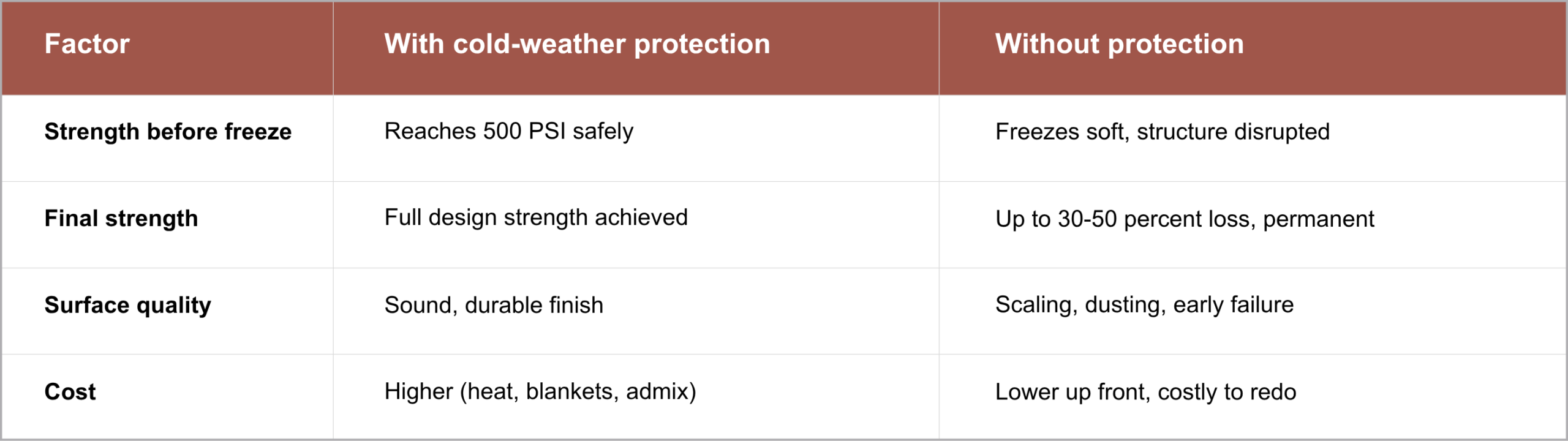
Winter Pour at a Glance
Here is a quick reference for what a properly managed winter pour involves compared with the risks of skipping the precautions.
Should You Pour Now or Wait Until Spring?
For many homeowners, the honest answer is that spring or fall is the easier and more economical time to pour. A mild-weather pour needs none of the heating, blankets, or enclosures that add cost and complexity in winter. If your project can comfortably wait, our companion guide on the best time of year to pour concrete in Central Iowa walks through the ideal seasonal windows in detail.
That said, plenty of projects cannot wait. A driveway that has failed, a foundation on a build schedule, or a repair that is creating a safety or access problem does not pause for the calendar. In those cases, a winter pour handled with full cold-weather protocol is a completely legitimate solution. The key is not the season on the calendar; it is whether the crew genuinely follows the 500 PSI standard and has the equipment and experience to hold the concrete safe until it gets there.
What This Means for Your Project
So, can you pour concrete in winter in Central Iowa? Yes, and it can turn out beautifully, but only with strict adherence to cold-weather standards built around the 500 PSI freeze threshold. Heated water, non-chloride accelerators, a thawed subgrade, insulated curing blankets, and heated enclosures when needed are what keep a winter slab from freezing before it gains strength. Cutting those corners is where winter concrete goes wrong.
At Top Tier Construction, we have spent more than twenty years pouring concrete across Des Moines and surrounding communities including West Des Moines, Waukee, Clive, Urbandale, Ankeny, and Johnston. We know how our winters behave, and we build every cold-weather pour around the standards that protect it for the long haul. If you are deciding whether to move forward this winter or plan for spring, we are glad to look at your specific project and give you a straight answer. Reach out today to request a free estimate, and see our full list of service communities on our areas we serve page.