
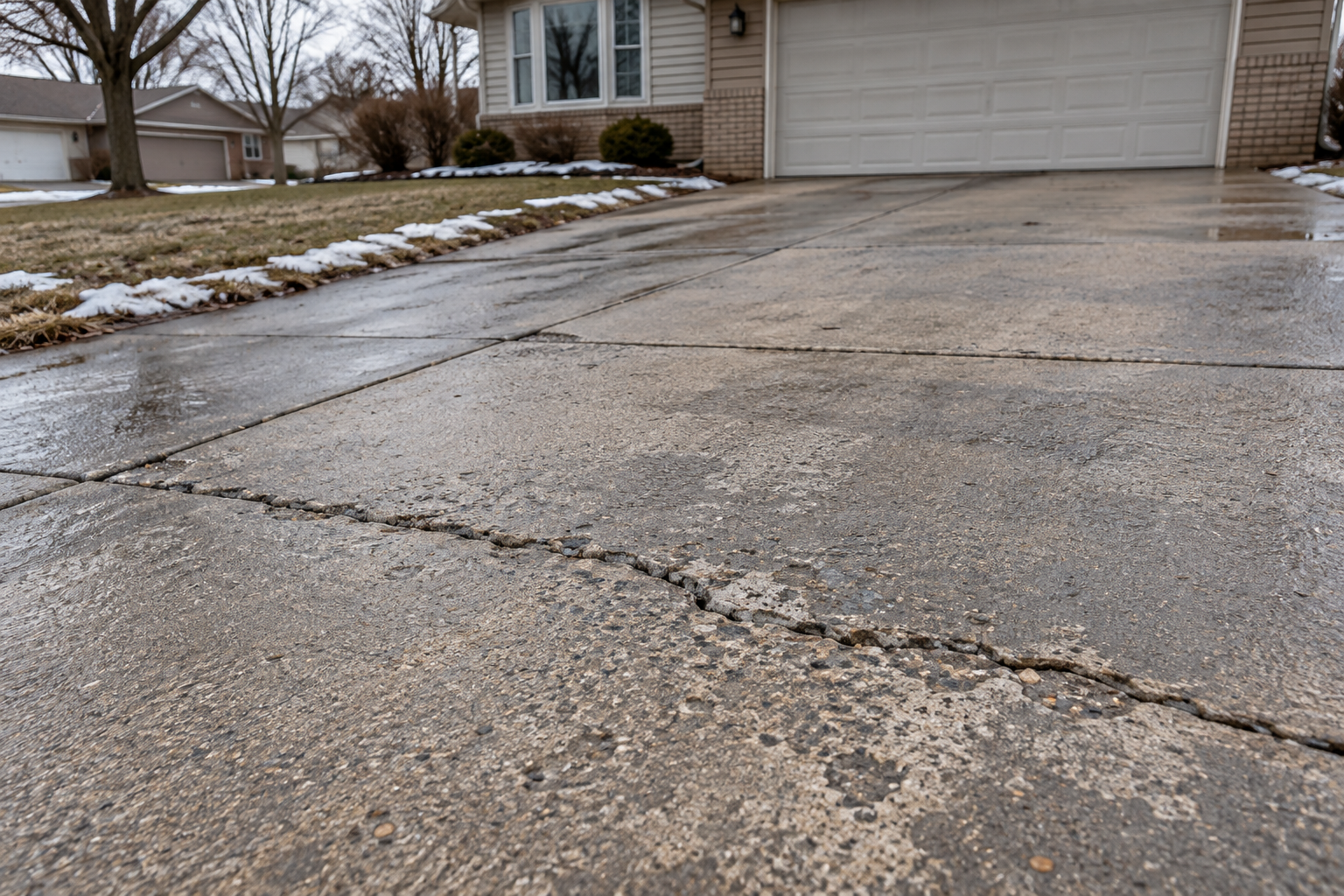
If you have noticed a crack creeping across your driveway or patio, you are not alone, and you are right to ask why concrete cracks in Central Iowa so often. Our region puts concrete through one of the harder tests in the country. Summers are hot and humid, winters drop well below freezing, and the ground swings between the two every single year. That constant movement is tough on any slab, and it is the reason cracking is such a common concern for homeowners around Des Moines.
Here is the reassuring part. Not every crack is a problem, and most cracking is preventable with the right preparation and materials. Some fine lines are simply concrete behaving the way concrete does, while others are early warnings that something under the slab needs attention. Knowing the difference tells you when to relax and when to call a professional.
This guide breaks down the real causes of concrete cracking in our climate, shows you which cracks matter, and lays out the steps that keep a slab solid for decades. Whether you are maintaining a driveway or planning a new pour, these basics help you protect your investment and hire the right crew.
The Main Reasons Concrete Cracks Here
Most cracking traces back to a handful of causes. In Central Iowa, these are the ones we see most often on local job sites.
Freeze-Thaw Cycles
This is the single biggest culprit in our climate. Water seeps into the tiny pores of a slab, freezes, and expands, then thaws and repeats through every winter. That pressure pries the concrete apart from the inside, showing up as surface flaking, called spalling, and as widening cracks. Air-entrained concrete and a good sealer are the main defenses.
Poor Subgrade Preparation
A slab is only as stable as the ground beneath it. When the base is not compacted properly, or soft spots are left in place, the concrete settles unevenly and cracks under its own weight. Central Iowa’s clay-heavy soils make this worse, because clay swells when wet and shrinks when dry. Proper grading and compaction before the pour prevent most settlement cracks.
Shrinkage While Curing
Fresh concrete shrinks slightly as it cures and loses moisture. If it dries too fast, especially in summer heat, the surface can crack before it gains strength. These shrinkage cracks are usually thin, but they are a sign the pour was rushed or poorly cured. Controlled curing and proper timing keep them to a minimum.
Missing or Misplaced Control Joints
Control joints are the grooves cut into a slab that tell it where to crack. Placed correctly, they hide cracking along clean lines. Left out or spaced too far apart, the concrete cracks wherever it wants, often right across the middle of a driveway. Correct joint placement is one of the clearest signs of an experienced crew.
Heavy Loads and Tree Roots
Some cracks come from stress the slab was never built to handle. Common local causes include:
- Heavy vehicles or equipment parked on a residential-grade slab
- Tree roots growing under and lifting a section of concrete
- Downspouts dumping water against the edge of a slab and eroding the base
Which Cracks Should You Worry About?
Not all cracks carry the same weight. A quick visual check tells you a lot before you call anyone.
Cracks That Are Usually Cosmetic
These are common and rarely a cause for alarm:
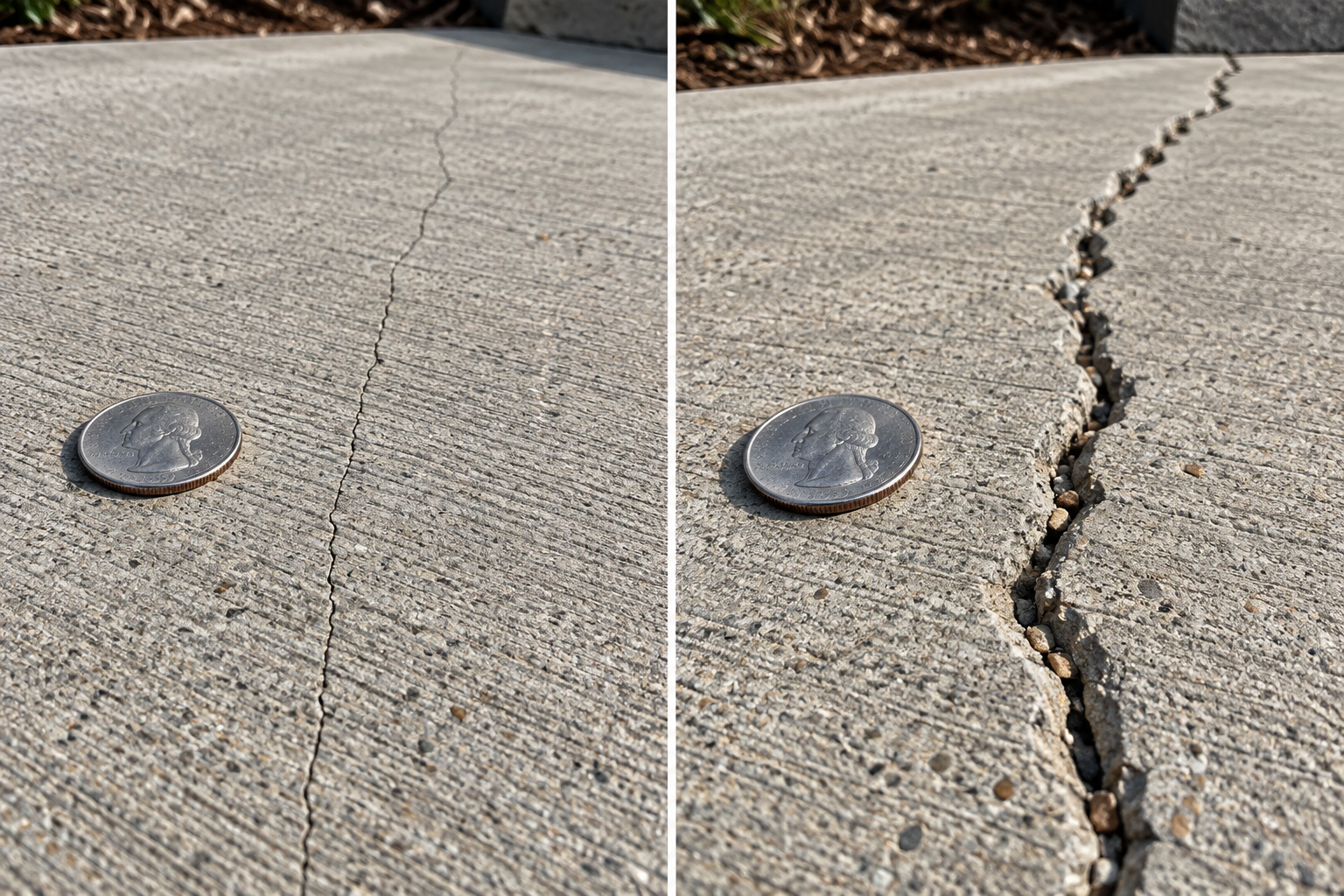
- Hairline cracks thinner than a credit card, especially along control joints
- Fine surface crazing that looks like a shallow web
- Short, stable cracks that have not changed in months
Cracks That Need a Contractor
These deserve a professional look sooner rather than later:
- Cracks wider than about a quarter inch, or wide enough to slip a coin into
- Uneven slabs where one side sits higher than the other, a sign of heaving or settling
- Cracks that keep growing, branching, or returning after a patch
- Any crack paired with pooling water, crumbling edges, or exposed rebar
How to Prevent Concrete Cracks
Prevention is far cheaper than repair, and most of it happens before and just after the pour. The steps that matter most are straightforward:
- Insist on proper subgrade prep, with the base graded and compacted before any concrete is placed
- Use the right mix, including air-entrained concrete rated for freeze-thaw exposure
- Make sure control joints are cut at correct spacing for the slab size
- Cure the slab properly rather than rushing it, so it gains strength evenly
- Seal the finished concrete and reapply every few years to block water intrusion
- Keep water moving away from slabs with good drainage and redirected downspouts
Industry guidance from the American Concrete Institute backs each of these practices. A crew that follows them delivers concrete that resists our climate for the long haul, which is exactly what protects your investment.
Repair or Replace? How to Decide
When a crack does show up, the fix depends on its cause and severity:
- Repair works when cracks are narrow and stable, the slab is level, and the base is sound. Sealing and resurfacing can extend the life of the concrete for years.
- Replacement is the better call when the slab has heaved or settled, cracks are wide or spreading, or the same section keeps failing. Patching a failing slab only hides the underlying problem.
For structural work that changes drainage or grading, it is worth confirming any local requirements through the Des Moines Permit and Development Center before starting. A trustworthy contractor will tell you honestly which path fits your situation rather than defaulting to the most expensive option.
Frequently Asked Questions
Why did my brand-new driveway crack already?
A little hairline cracking during the first months is normal as the slab cures. A wide or uneven crack this early usually points to subgrade or curing problems and should be inspected.
Can I fill concrete cracks myself?
Small cosmetic cracks can be sealed with a quality crack filler as basic maintenance. Anything wide, uneven, or growing is worth a professional look before you spend money on a patch that may not hold.
Will cracks keep getting worse?
Stable hairline cracks often stay put for years. Cracks tied to freeze-thaw, drainage, or settling tend to widen over time, which is why sealing and good drainage matter so much locally.
Talk to a Central Iowa Concrete Contractor
Concrete cracking is common here, but it is not something you simply have to accept. Most of it comes down to preparation, materials, and knowing the local climate, and most of it is preventable with the right crew. When cracks do appear, the key is reading them correctly and fixing the cause, not just the symptom.
Top Tier Construction has spent more than twenty years pouring and repairing concrete across Des Moines and surrounding communities including West Des Moines, Waukee, Clive, Urbandale, Ankeny, and Johnston. We prep every base properly and build every slab to handle the freeze-thaw cycle. Explore our professional concrete services in Des Moines, see our concrete driveway installation and repair options, and reach out for a straight assessment of your cracked concrete.